Key Specifications
GPU: NVIDIA GeForce GT 730 (GF108)
CUDA Cores: 384 zotac.com+12B&H Photo Video+12zotac.com+12Newegg.com+7Staples.com+7Newegg.com+7
Core Clock: ~902 MHz B&H Photo Video+7Zones+7Newegg.com+7
Memory: 4 GB DDR3 running at 1.6 GHz effective
Memory Interface: 64-bit → ~40 GB/s bandwidth eBay+2B&H Photo Video+2Zones+2
Interface: PCI Express 2.0 x16 (or x8 electrically) publicsector.shidirect.com+10Zones+10Network Hardwares+10
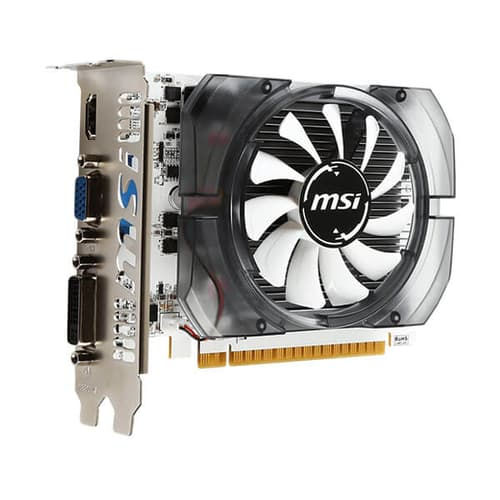
Cooling: Low-profile, fanless passive heatsink – completely silent B&H Photo Video+3Network Hardwares+3publicsector.shidirect.com+3
Form Factor: Single‑slot, compact design (~146 × 111 mm) suited for mini‑ITX or HTPC builds Network Hardwares
📺 Display Outputs & Capabilities
Outputs: 1 × HDMI, 1 × Dual‑Link DVI‑I, 1 × VGA
Up to 3840 × 2160 (4K) @ 30 Hz via HDMI; DVI supports 2560 × 1600 @ 120 HzNewegg.com+3B&H Photo Video+3Network Hardwares+3Zones
Supports triple‑monitor setups via NVIDIA Surround zotac.com+3zotac.com+3Network Hardwares+3
🎧 Media & Audio
Hardware‑accelerated Blu‑ray 3D playback
Audio passthrough: Dolby TrueHD & DTS‑HD bitstream; ideal for HTPC use zotac.com+3foreteconline.com+3Staples.com+3zotac.com+4zotac.com+4zotac.com+4
⚡ Power & Efficiency
Typical TDP: ~25 W – extremely low power draw
Power requirement: Only needs standard PCIe slot power, PSU as low as 300 W is sufficient for most builds Network HardwaresZones
🕹️ Performance Considerations
Released in mid-2014 (June), built on a 40 nm process, using GF108 GPU techpowerup.com
GT 730 class cards offer modest performance: sufficient for general desktop tasks, HD video decoding, basic photo or light editing, non‑GPU‑intensive workloads B&H Photo VideoStaples.com
Not ideal for modern gaming—even at low settings; performance is limited by DDR3 bandwidth and aging driver support reddit.comlinustechtips.com
✅ Use Cases & Strengths
Silent, low‑profile GPU for media centers, office work, light photo/video editing
Supports multi-monitor productivity (up to 3 displays)
Efficient upgrade from integrated graphics in older systems
⚠️ Limitations
Being DDR3‑based with a 64‑bit bus severely restricts performance in 3D workloads
Struggles with modern DirectX 12 games (feature‑level limited to 11_0) B&H Photo Video+1Amazon+1techpowerup.com+1Newegg.com+1
4 GB of VRAM more marketing than usable capacity; GPU bottleneck remains the limiting factor in most tasks linustechtips.com
📊 At a Glance
Feature | Detail |
GPU | NVIDIA GT 730 GF108 |
CUDA Cores | 384 |
Core Clock | ~902 MHz |
Memory | 4 GB DDR3 @1.6 GHz, 64-bit |
Memory Bandwidth | ~40 GB/s |
Outputs | HDMI, DL‑DVI‑I, VGA (triple display) |
Cooling | Fanless, passive heatsink |
Power Draw | ~25 W |
Recommended PSU | ≥300 W |
Form Factor | Low-profile, single-slot |
🎯 Bottom Line
The ZOTAC GT 730 4 GB DDR3 is a niche card best suited for quiet, compact builds aimed at media playback, basic editing, and light productivity with multi-monitor setups. It's not recommended for modern gaming or GPU‑accelerated workloads—those would be better served by cards with GDDR5/6 memory and a wider memory bus.
Feel free to ask if you want comparisons to other cards or recommendations within your budget or use case!
Sources